Friday, September 20, 2013

Avenging Mom with fire

We didn't plan it this way, but our next two films have a remarkable amount in common:
  • distinctive and intriguing titles;
  • mothers preoccupied by witchy thoughts of revenge, and daughters who get caught up in their schemes;
  • scenes of fire and catharsis, in which the movie's proletariat is at last invited to let loose;
  • murky plots that left us scratching our heads over certain key details;
  • and, courtesy of Mill Creek, terrible transfers with very bad sound, which surely don't do the movies in question any favors.
So in this spirit of ennui and motherhood, let's dive in:


Chloe, Love is Calling You (1934)

Grade: F


As Kelsey Grammer would say, "Oh, dear Lord."

Let's get this out of the way up front: the only saving grace of Chloe, Love is Calling You is the historically significant footage of the Shreveport Home Wreckers. Their performance, though brief, is certainly a highlight.


Otherwise, this atrocious melodrama in the "one drop of black blood" vein manages to be both offensive and boring, which is no small feat. Olive Borden (in her final screen role) is almost plausible as Chloe, a girl who yearns to escape the not-entirely-loving arms of her mother, the voodoo priestess Old Mandy (Georgette Harvey). Old Mandy fled after her husband Sam was lynched many years ago, and now she and Chloe have come back to their old home.


Chloe's decidedly unmelanistic appearance is explained by the fact that she's allegedly "high yella", or mixed-race. And okay, it's not inconceivable that Olive Borden could be mixed-race; she looks more Joyce DeWitt (or Gilda Radner) than Lena Horne, but whatever.  But this guy?


Yes indeed: they chose Philip Ober, best known as "the guy who married Vivian Vance and beat her up", to play Jim Strong, the movie's second mixed-race character. (What kind of person would beat up Vivian Vance, for God's sake?)  Mr. Ober was many things, but a plausible non-Caucasian was not one of them, and even in 1934 one has to imagine his casting must have elicited giggles in the audience.

Jim is utterly besotted with Chloe, and even wrestles dead alligators on her behalf to prove his love:


But she'll have none of it, and instead pines for local plantation foreman Wade Carson (Reed Howes), who returns her affections -- but doesn't realize she's black. (Cue dramatic music here.)

Still, Chloe and Wade fall madly in love, leaving poor Jim out in the cold. A noble soul even so, he saves Wade's life not just once, but twice, and barely gets a thank-you in return.

(He could've at least sent a card. One imagines that the local gift shop in Chloetown would've had "Thanks for saving me from murderous minorities" stocked in both A1 and A7 sizes, since every non-white character in the movie except Chloe and Jim is either servile or treacherously homicidal.)


Now, Wade has recently started working for the genteel Col. Gordon (Francis Joyner). Years ago the Colonel lost a daughter, Betty Ann, under mysterious circumstances: she was presumed to have drowned, but her body was never found.  (You can probably see where this is going.)


The chief roadblock in Chloe's road to happiness (and not-black-ness) is Old Mandy. She holds Col. Gordon responsible for Sam's lynching, which some reviews of the movie seem to take at face value. But racist though Chloe, Love is Calling You is, it's not Birth of a Nation, and as far as we could tell the sequence was actually meant to be:
  • Col. Gordon fires Sam (probably for stealing, since the movie makes a point of showing Wade confronting a pre-existing workplace culture of employee theft);
  • Sam attacks Col. Gordon, knocks him unconscious, and escapes;
  • then an unspecified group of "folks" pursues, catches, and lynches Sam, without the Colonel's knowledge or encouragement.
Not that it made a big difference to Sam, of course, but the bottom line (we suppose) is that Old Mandy is taking revenge on the wrong man. And in fact, there's a little hint of "the cycle of violence ends here" in the movie's closing scenes, when the Colonel pointedly notes that he wants to prevent a second lynching.


At least Chloe, Love is Calling You is short. But it's terrible, and thanks to the poor audio and shaky picture, it's literally hard to watch.  So unless you're interested in black screen presence in early talkies -- or in the Shreveport Home Wreckers -- avert your eyes and ears, and be the happier for it.


The Long Hair of Death (1964)

Grade: D-

As a wise man once said, "OH, NO! NOT THE BEES! NOT THE BEES! AAAAAHHHHH! OH, THEY'RE IN MY EYES! MY EYES! AAAAHHHHH! AAAAAGGHHH!"


Or, perhaps more to the point: "BITCHES! YOU BITCHES!"


Barbara Steele plots and schemes her way through this mediocre Italian gothic tale of murder, revenge, and creepy (though not terribly convincing) medieval dungeons. The film opens on a rather festive note, as an accused witch flails about in the midst of a flaming maze of hay bales and cross-shaped scaffolding. A stylish change from the typical crone-on-a-stick set-up, we thought.


Meanwhile, upstairs in the castle, the woman’s eldest daughter Helen (Steele) endures the sleazy advances of the local nobleman, who promises to spare mom in exchange for a little rapporto carnale.  It makes no difference, of course: the crispy witch expires, but not before cursing the village and imploring her two daughters to avenge her death.


Revenge, however, will have to wait. Helen is abruptly offed by the Count in the next scene (to the outrage of Steele fanboys everywhere, we’re sure) and the other daughter, Elizabeth -- just a child, at this point -- is, perversely, entrusted to the Count’s household. Keep your enemies close, we suppose, or pray that Stockholm syndrome does its magic.

All this is a prelude to the real action, which takes place a decade or so later amid the Black Death or some similar plague. Elizabeth (Halina Zalewska), by now a petulant, sulking sourpuss of a woman, is married, against her will, to the Count’s son Kurt (George Ardisson) -- a boorish Shatner lookalike with a penchant for frilly shirts and pig-headed chauvinism.
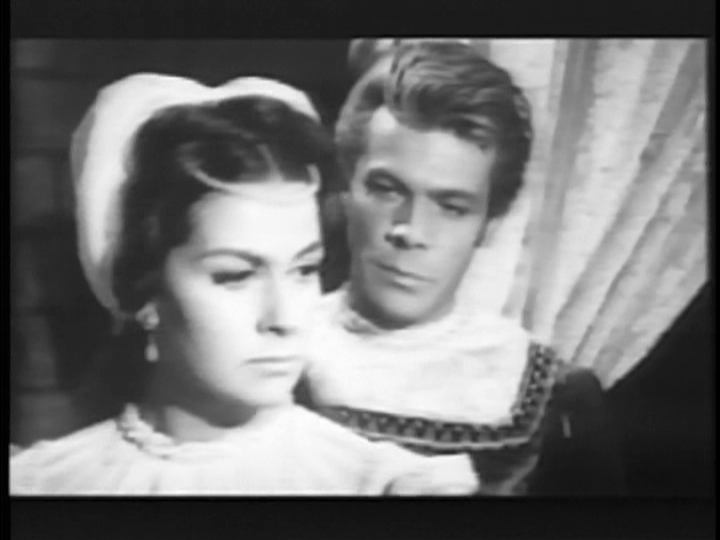


Things aren't going so well for Elizabeth, but soon the requisite dark and stormy night blows in a mysterious figure -- why, if it isn't good ol' Barbara Steele, back from the great beyond! At least, we guessed it was the great beyond. Here is where things got somewhat murky (murkier than the terrible Mill Creek print, if you can believe it). Now Steele claims she's a traveler named Mary, and everyone in the household seems to go along with this fiction (except poor old Count Humboldt, who keeled over from the shock). Not even a flicker of recognition from Kurt, the staff, or, significantly, her own sister.


Plot hole, or lost in translation? Who knows or cares, because soon the film turns into a long, slow, murky slog to the finish. Kurt, predictably, falls under the spell of the mysterious Mary, who seems to oscillate between wanting it and not (women, right?), and the two of them eventually plan to do away with Elizabeth permanently. There's a ton of gabbing around the dinner table, skulking in dungeons, mooning about the bedroom, and a generous helping of not getting on with things.


Other reviewers of this film (and there are many) seem to fall into two schools: first are those who agree that, yes, it does get rather dull in the middle -- but that it's not really relevant, because Barbara Steele is just such a talented actress. Then there are those who rabidly insist that no, what you plebes call dragging is actually mood and atmosphere and a building sense of dread.


As to the latter, all we can say is that we tend to love films where nothing much happens (Idaho Transfer, anyone?), but there's a difference between good atmosphere and pea soup. As to the former? No accounting for taste, we suppose. It is our expert and informed opinion that both sets of reviewers enjoy this movie for precisely one reason. Well, two reasons.


Inexplicably, nobody else seems to be bothered by the score, which is heavy-handed, mind-numbingly repetitive, and by its presence alone threatened to put this film firmly in "F" territory. We decided on a "D-" simply because we were genuinely curious about how things would all turn out. Though reminding us not unpleasantly of a similar denouement in a more recent film -- and there is something vaguely Summersisle about all the women, it should be said -- ultimately, we were left feeling unsatisfied. Next time the Italians have a zany adventure, we'll make sure they bring a big tomato sauce.


Sunday, August 25, 2013

Tales of canine bravery and wisdom

These next two films are, as far as we know, the only ones left in our backlog: one is a recent watch that we hadn't written up yet, and the other is a movie we skipped out of laziness.

Getting this unfinished business cleared up is pleasant enough, but it was even nicer to realize they also share a theme: in each, one of the most important characters is a dog.


Beartooth (1978)

Grade: C+


This first film takes us out of Mill Creek territory and into the 2-DVD set 4 Movie Marathon: Grit 'N Perseverance, which we're hoping to review in full if we can get the discs successfully resurfaced (they're half-clean, half-trashed, so only two of the movies are currently watchable).

Anyway, this set was our source for 1978's Beartooth -- or, as the DVD case calls it, Beartooh:


In certain films, there's a moment early on -- maybe 20 minutes in, depending on the runtime -- when you realize something important about the movie you're watching, something that will shape your experience of the remainder of the film.  And that realization is: Nothing is going to happen in this movie.


Or, phrased more generously: This movie isn't about plot, but about character, atmosphere and a sense of place.


Now, in the case of Beartooth, that's not strictly true.  It has a plot (albeit one that could be summarized in two sentences with very little loss of information), and it even has peripeteia and anagnorisis.


But it also has long, long stretches where nothing is happening except some combination of: (a) beautiful Technicolor vistas of the American Rockies, (b) the strumming of the world's jangliest banjo, (c) stock footage of wildlife, and/or (d) Dub Taylor doing his chores while his dog Sugar keeps him company.


Your patience for this sort of thing, and your tolerance for sweet-natured stories of grizzled, lonely old mountain men who find lifesaving companionship in canine form, will heavily shape your enjoyment of Beartooth. We watched it while suspended thousands of feet in the air, in the last stage of a long and stressful transcontinental trip, and as K. said, "it was just what the doctor ordered."


Though there's almost no information on the Internet about Beartooth, it seems likely that it was intended as an educational film, or perhaps as a product to sell to schools and communities. At the very least it was produced by Educational Services Inc., and one can't help but notice that Dub Taylor's character, "old" C.J. McDonald (as he describes himself), never utters an oath any stronger than "Dadgum!"


And one more crucial point: the DVD cover features a promotional image of a snarling bear with razor-sharp teeth exposed, looking ready to kill. (Apparently, Amazon.com also uses the same image for its digital download/rental.) But if you come to Beartooth looking for pulse-pounding scenes of C.J. McDonald doing battle with a grizzly, you will be sorely disappointed: the only bears seen in Beartooth are part of stock footage montages.


It would be difficult to exaggerate the extent to which Beartooth is, in fact, the opposite of such a movie. Speaking solely in bear terms, it's far closer to Grizzly Man than Grizzly, but minus Werner Herzog.


Really, the closest archetype for Beartooth would be the evocative Canadian educational shorts they used to play on PBS on weekday mornings when you'd be home from school, sick in bed. If you have fond memories of those, you might like this, but horror fans should almost certainly steer clear.


Embryo (1976)

Grade: B+


Our K. had seen this Rock Hudson vehicle before (which is why we skipped over it in our first pass through Nightmare Worlds), but only barely remembered it; our P. hadn't, and his expectations were totally confounded.


Not a monster movie starring some grotesquely deformed fetus with psychic powers (and room for a pony), it's instead a kind of variation on Flowers for Algernon, except this time Charly Gordon is smart, hot, and female.


And Algernon is a Doberman named Number One, and doesn't die. Plus he cleans up his messes.


Apparently Embryo has gotten poor reviews in some quarters, and some reviewers absolutely loathed the movie. But we found it totally engaging up until the last five minutes, when it finally degenerated into the kind of schlock we'd been expecting all along (and were pleasantly surprised not to have gotten).


We have to give a special shout-out to the dog that played Number One (sadly uncredited), whose obvious intelligence and calm dexterity impressed the hell out of us both. Good actor, too, with inquisitive eyes, a convincing head-tilt, and a terrifying growl: we wouldn't want to be bacon on a sawhorse when Number One got in a bad mood.


In fact, Number One was probably the best performance in the movie, so it's a crime that we can't praise him (or her? -- we didn't check) by name. If there isn't a canine version of the Screen Actors Guild, there surely should be!

Friday, August 23, 2013

The Umbrellahead Awards: 50 Horror Classics Division

Once more we've hit a milestone, as we've made it through the portion of our Horror Collection 250-pack that's essentially a copy of the 50 Horror Classics box set.  So, without further ado (and only three years and change after the first one), here's the second edition of the Umbrellahead Awards.


Actual Best Movie Award:

Nominees:
The Amazing Mr. X
Carnival of Souls
Creature from the Haunted Sea
Little Shop of Horrors
The World Gone Mad

Winner:
The World Gone Mad

All five of these movies engaged us from start to finish, and we were seriously considering The Amazing Mr. X for the top spot -- but in a surprise upset, we opted to give high honors to this compelling tale of finance and fraud.

(If our decision is unduly influenced by The World Gone Mad's uncanny timeliness, well, we can live with that.)


Actual Worst Movie Award:

Nominees:
Atom Age Vampire
Nightmare Castle
Phantom from 10,000 Leagues
The Screaming Skull
The Terror

Winner:
Atom Age Vampire

In this dire quintet, we have to single out Atom Age Vampire for its heady combination of false advertising, weaksauce exploitation, and content so dreary and unmemorable that we hardly remember seeing it.


So-Bad-It's-Good Award:

Nominees:
The Beast of Yucca Flats
The Brain that Wouldn’t Die
The Indestructible Man
Maniac
Revolt of the Zombies

Winner:
Maniac

If Maniac can trump even the pleasure of watching the great Mazovia, that should give you an idea of how wonderfully insane, how startlingly graphic, how utterly WTF a film it is, and what a one-of-a-kind experience it offers the viewer. An absolute must-see.


Ye Olde Filmes:

Nominees:
Bluebeard
Dr. Jekyll & Mr. Hyde
The Hunchback of Notre Dame
Nosferatu
The Phantom of the Opera

Winner:
The Hunchback of Notre Dame

This battle was largely fought in musical terms: three of these movies are silent films with needle-drop soundtracks, and one (Bluebeard) is a talkie with a horribly overpresent score. That leaves The Hunchback of Notre Dame, which benefits immeasurably from the carefully crafted music which accompanies the film throughout.


Worst Use of a Primate:

Nominees:
The Ape
The Gorilla
The Monster Maker
The Monster Walks

Winner:
The Monster Walks

If there's any recurring theme that's utterly worn out its welcome, it has to be the "ape in the basement" trope, and all four of these movies invoke it to their detriment. But The Monster Walks takes the prize for featuring a real chimpanzee that almost assuredly was abused and/or mentally ill, and for using the chimp to set up the film's not-so-subtly racist denouement.


Most Ridiculous Beast Award:

Nominees:
Attack of the Giant Leeches
The Giant Gila Monster
The Killer Shrews
Monster from a Prehistoric Planet
Phantom from 10,000 Leagues

Winner:
The Killer Shrews

Dogs in rugs, people. Dogs in rugs.


Battle of the Bélas:

Nominees:
Black Dragons
The Corpse Vanishes
The Gorilla
Invisible Ghost
One Body Too Many
White Zombie

Winner:
White Zombie

Of the six Béla Lugosi movies in this portion of the box, White Zombie certainly offers him the juiciest role, as the diabolical slavemaster Murder Legendre. A flawed but seminal film, White Zombie also gets the nod for its array of memorable visual and aural images.

(The mill scene -- with its wild soundtrack of grinding machinery like a tormented saxophone in its death throes -- sticks in P.'s mind.)

And speaking of zombies:


The Zombie Chic Is So Last Week Award:

Nominees:
King of the Zombies
The Last Man on Earth
Night of the Living Dead
Revolt of the Zombies
White Zombie

Winner:
Revolt of the Zombies

The zombies are revolting! You'd probably expect Night of the Living Dead, but it gets disqualified since we haven't actually watched the Mill Creek copy (we caught it on public television over one Halloween instead).

King of the Zombies is too racist, Last Man on Earth too interminable, and we just did White Zombie, so that leaves...Mazovia.


The "Fangs for the Memories" Award:

Nominees:
Atom Age Vampire
The Bat
Dead Men Walk
Nosferatu
The Vampire Bat

Winner:
The Bat

Nosferatu is probably a better capital-M movie, but we're feeling fond of this Agnes Moorehead and Vincent Price vehicle. Heck, it even has a real bat in it.


The "Who Can Kill A Child?" Award

Nominees:
Dementia 13
Last Woman on Earth
The Mad Monster
Tormented

Winner:
Last Woman on Earth

This is an easy one. Tormented chickens out just when the kid's about to get it, and Dementia 13 kills a kid in a flashback, while the title character in The Mad Monster also manages to include a little girl in his murderous forays.

However, Last Woman on Earth far exceeds both of these films by killing all the children, everywhere -- and refusing to make more, to boot. Who can top that?


The Most Egregiously Not A Horror Movie Award:

Nominees:
Doomed to Die
The Fatal Hour
A Shriek in the Night
Swamp Women
The World Gone Mad

Winner:
The World Gone Mad

Much as we hate to double up, and much as we were grateful for the chance to see The World Gone Mad, including this crime-and-finance drama in a soi-disant "horror" box set is aggressively inappropriate.


The Most Egregiously Not A Teenager Award:

Robert Reed was an adolescent once, but when Bloodlust was filmed, he was in his late twenties. By casting the future Mike Brady as a brave teen, we knew -- it was much more than a hunch -- that plausibility was on its way out the window.


The Third-Act Letdown Award:

So much style, so much promise in Dementia 13's early stages. But when Coppola decided to kill off the most interesting (and hottest) character, it was all downhill from there.


The A For Architecture Award:

Bravo to House on Haunted Hill for using the attractive and refreshingly modern Frank Lloyd Wright-designed Ennis House as the exterior for the titular abode. Who says a haunted house needs to be a pointy confusion of turrets, gables, and cupolas? (Too bad the interior set designers didn't get the memo...)


The We-Didn't-Bother Award:

Since P. has never seen Metropolis, and since so much lost material has come to light over the past few years, we can't help but think we'd be doing this cinematic classic an injustice by watching the Mill Creek version. We'll hold out for a DVD of one of the restored prints.

Thursday, August 22, 2013

Don't watch these, Prince

We like Mill Creek. Really, we do. But sometimes they put out a print that's just so damaged, hacked up, worn to bits, or umpteenth-generation that we have to warn our loyal readers to steer clear, because even the most indulgent and imaginative viewer can't compensate for what's been lost. And crucially, there are better copies of these movies out there -- in one case, you can get a free copy legally! -- so it clearly didn't have to be this way.

But verily, the sad hand of cheap-ass commerce has left its fingerprints all over this next pair. So if the question is "Should I watch the Mill Creek versions of these movies?", the answer is most assuredly "I don't think so."

(But maybe it'd help to have some Dunk-a-roos to snack on. Or Hulkaroos for that matter, if you're feeling especially Minnesotan.)


The Ape Man (1943)

Objective Grade: D
Hairy Hungarian Bonus: C+
Poor Print Penalty: F


Inevitably there's a degree of pathos associated with seeing Béla Lugosi wasting his talents in a piece of silly dreck like The Ape Man. But unlike some of his later roles, the charismatic Hungarian still has enough physical presence to pull this one off -- which, paradoxically enough, makes it easier to laugh at the whole thing.


In fact, the makers of The Ape Man encourage us to laugh right from the start, and we're not merely talking about anachronistic double-entendres like "After today, you'll be shooting that one-eyed monster of yours for Uncle Sam." Maybe they wanted to hedge their bets, aware that the premise of The Ape Man was so risible, and Béla's makeup so ridiculous, that even schoolchildren might find the whole thing laughable.


What seals the deal: from the very beginning of the film, an enigmatic man lurks in almost every scene -- sometimes as an onlooker, sometimes as a participant. By the time we find out who this goofy, creepy, Ryan Stiles-esque figure is, it signifies that The Ape Man has, once and for all, abandoned all pretense of sincerity. (Meta was by no means an invention of the late 1990s, folks.)


We're assuming you don't need us to tell you that Béla's a scientist on the brink of insanity, or that a spunky female reporter is one of the protagonists, or that there's a gorilla in the basement. Such things, you understand, are de rigueur.


Why you shouldn't watch this print:
While the picture on this copy isn't too bad, the audio is positively, absolutely atrocious. It's terribly muffled, but even if you try to compensate with EQ, what's left is far too damaged to work with. As a result, much of the dialogue is incomprehensible, and we were lucky to understand 50% of what was said, even after multiple replays.


What to watch instead:
Look no further than the wonderful Archive.org, which has a downloadable copy of The Ape Man with much, much better sound quality.


The Night Evelyn Came Out of the Grave (1971)

Grade: D+
Markdown for the Mangling of Motivation (and Milk): F


Poor Lord Alan Cunningham (Anthony Steffen). He's nobility, he's filthy rich and he's handsome, but he just can't get over his late wife Evelyn. Part of the problem is that he has an odd approach to grieving: whenever he sees a certain kind of redhead, he has to have her...


...and then he has to kill her.


The title of this movie tells us that things will get even messier in the Evelyn department, and indeed they do. What's less clear is whether any of it makes any sense, and on second viewing the whole thing seems all the more creaky and indulgent (bordering on incoherent).


To distract us from the silliness of the narrative, we get an array of visual stimuli including not-so-sexy dancers, groovy hippie bands, and fleet foxes. But unlike some other films (e.g. Kiss Me Kill Me), The Night Evelyn Came Out of the Grave doesn't have enough style (or eye candy) to engross the viewer on that basis alone.


But does the Mill Creek copy give us sufficient basis to form a judgment? Read on for the answer.


Why you shouldn't watch this print:
OK, the image is perennially blurry and/or washed-out, and some of the nighttime scenes are tough to make out. That's to be expected, and if you can't tolerate VHS quality, you have no business buying Mill Creek boxsets. But a good 15-20 minutes have been edited out of this copy, mostly (we assume) to cut out nudity. 

However, the excised material wasn't just T&A, but also included crucial dialogue that explains Alan's murderous behavior, as well a key scene involving a missing glass of milk (in the edited version they allude to this, with no context whatsoever). With it intact, the film makes one hell of a lot more sense.

What to watch instead:
We're not going to link to it, but an unedited, full-length, widescreen copy of The Night Evelyn Came Out of the Grave is on YouTube. It's in Italian, but has an option for English-language subtitles, and looks light-years better than the Mill Creek copy, especially in the darker scenes. It made us say things like "Colors!" and "Contrast!", which are words we don't get to say much under the Umbrellahead umbrella.

Oddly, this post on IMDb made us expect an alternate ending, but either that person's imagining things or it's simply not in this version, because the ending was the same as the Mill Creek copy.


As a side note, we've finally caught up with our backlog of reviews, which dated back to 2011 (!) when we resumed posting earlier this month.  We're planning to review one more movie we watched quite recently (a non-Mill Creek affair that mostly seems to have been forgotten by the Internet), and we'll also do a brief recap of the 50 Horror Classics subset that spanned from Carnival of Souls to Phantom from 10,000 Leagues.