Friday, June 2, 2017

Telephone secrets, telephone spies

"Can you hear me? Or am I talking to myself?" - Chris Squire (RIP)

In these two killer films from Poverty Row, the folks availing themselves of Ma Bell's services surely aren't talking via satellite (or Verizon), but can still hear each other just fine.

Little do they know, though, that an eavesdropping third party is listening in close to get the information right.


I Killed That Man (1941)

Grade: C+

Anyone who's seen enough Poverty Row crime flicks has seen the devices of I Killed That Man a dozen times over already, like the spunky female reporter (Joan Woodbury) who just so happens to be dating the A.D.A. (Roger Phillips).


Or the opening sequence that depicts the final moments of a condemned man before his execution...

...until he decides to admit that he is indeed guilty (yay, justice system!), but also had a secret partner in crime -- all revealed in a long speech that, for dramatic effect, saves the identity of his collaborator for last. And what's that? Why, it's a blowgun dart that kills him instantly, just as he's about to name names!

So next we get one of those "Nobody leaves this room!" numbers, which results in a whole lot of nekkid middle-aged men (mostly implied, so no luck if you're into that sort of thing). At least they get it out of the way upfront, vs. the absurd formal contortions we saw in Midnight Phantom.

I Killed That Man also does the "the culprit can't possibly be this guy, so of course it's this guy" bit that a New York Times reviewer skewered so well in A Shot in the Dark. TVTropes calls that sort of thing "hanging a lampshade on it", but for a murder mystery it's not such a wise idea.

Around now, you're probably wondering: "So, why the C+?" Well, it's amazing how much a brisk pace, a couple of clever set-pieces, and some good one-liners can do to salvage even the most familiar plot. And that certainly applies to I Killed That Man, which somehow manages to entertain throughout its 70 minutes.

For instance, when the gentlemen are putting their clothes back on post-inspection, we get this exchange:

Reed: "Never have I been so humiliated."
Lanning: "Felt kinda foolish myself. I guess I'll have to go on a diet."
Reed (bitterly): "So I noticed."

It doesn't really come off in print, but it's a sick burn in execution.


Returning to the subject of this post, we get a bumper crop of telephone-related plot points, including mysterious numbers, ice cream sodas, and a seldom-seen 3-way split-screen shot.

Is I Killed That Man a must-watch? Hardly. But it's one of those films that pops its head above the sea of Poverty Row mediocrity, rewarding the persistent viewer who wades through this stuff in hopes of turning up a hidden gem -- or, in the present context, simply something that's competent and entertaining. And that's exactly what we have here, so let's not press our luck by demanding more than that.


The Invisible Killer (1939)

Grade: D


Mill Creek's print of The Invisible Killer has one of the lousiest and most muffled soundtracks of any film on this boxset -- not to mention a series of nasty cuts and splices near its midpoint. Half the time we struggled to make out what was being said, but that's not necessarily a dealbreaker for us: after all, we liked The Ghost Walks.

What is damn near a dealbreaker, though, is this lady right here, Ms. Sue Walker:

Played by Grace Bradley, she's a relentlessly self-interested, Machiavellian journalist who goes well past "spunky" to the point that we nearly had to introduce a "nasty female reporter" tag. There's nothing wrong with amoral characters, of course, but Walker is so irritating and pointlessly difficult, we found ourselves wishing her love interest Lt. Jerry Brown (Roland Drew) would finally make good on his repeated threat to wring her neck.

It seriously detracts from a movie that isn't so hot to begin with. Maybe it's telling that so many sources seem to misunderstand the plot of The Invisible Killer, from the Mill Creek blurb saying "an eager female reporter...ends up partnering with a homicide detective assigned to the case" (misleading) to the IMDb claim that "a fiendish killer uses sound waves to commit his murders" (flat-out wrong).

What is the means of murder? Well, that would be blabbing.

The first two-thirds of The Invisible Killer drag like hell, in part because of the perennial 1930s "too many indistinguishable white guys in hats" problem. The presence of a secondary female character, attractive socialite Gloria Cunningham (Jean Brooks), does help a bit by allowing us to triangulate the identities of the IWGIH relative to her.

Ms. Cunningham is also the fiancée of the D.A., Richard Sutton (Crane Whitley), who's trying to rein in a wave of gambling-related crime...


...so it's very embarrassing when she's nearly caught up in an investigation: only Ms. Walker's forbearance keeps her from ending up on page one.
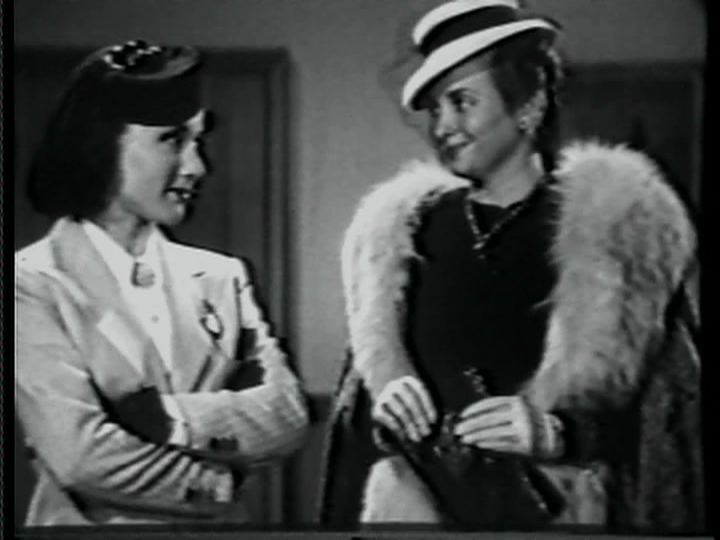
Worse yet is the fate of her father (Boyd Irwin), who fights on the side of right and justice, but discovers to his chagrin that he owns multiple properties used as gambling dens -- and once your hands are dirtied, it can be very hard to get clean.

Anyway, you can probably imagine much of the rest, but The Invisible Killer throws some weird curveballs. For example, there's Sutton's valet Worcester (David Oliver), a drunkard who spends his downtime slowly typing broadsides against "The Evils of Alcohol". We spend such a shockingly long time watching Worcester and his two-fingered technique that (we assume) he must be intended to serve as a key component of the film's comic relief -- or, perhaps, as a sardonic commentary on the hypocrisy of reformers.

But his scenes are so cut to ribbons by bad splices, and his typescript so hard to read in this print, that whatever impact the scene is meant to have is replaced instead by ennui and confusion.

Which, now that we think about it, is a pretty good description of what it's like to watch The Invisible Killer -- at least in its Mill Creek iteration.

Wednesday, May 31, 2017

Kaj nun por io tute malsama

Nu, Kapitano, kion vi faras en hororo filmo?


Incubus (1965)
[Inkubo]

Grade: C


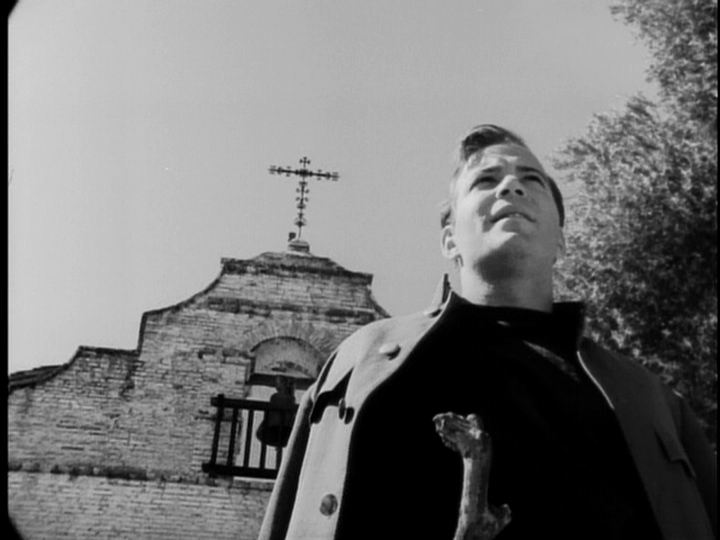
Continuing our detour from the Mill Creek box, we watched the Shat -- not to be confused with the Schach -- in Incubus, a film that manages to be infamous on multiple fronts. To wit: it was believed lost for many years, and the only surviving print has burned-in French subtitles. It allegedly carries a "curse" that, shortly after the film's completion, yielded two suicides (one of them a murder-suicide) among the cast members.

And -- oh yeah -- it's completely in Esper-fuckin'-anto. (That would be an example of an infix, for all you budding linguists out there.) Thus the burned-in subtitles, which are obscured by an ugly but necessary black box for the English-language subs.

Another site describes Incubus as "some kind of hybrid of an Ingmar Bergman film with Manos: The Hands of Fate", which is pretty much spot on -- though, at least plot-wise, you could probably throw in a dash of Night Tide too. It tells a moody tale of a succubus who drowns sinful men at the behest of an evil cult...


...until she meets a man who's not so easily corrupted. (Three guesses who.)

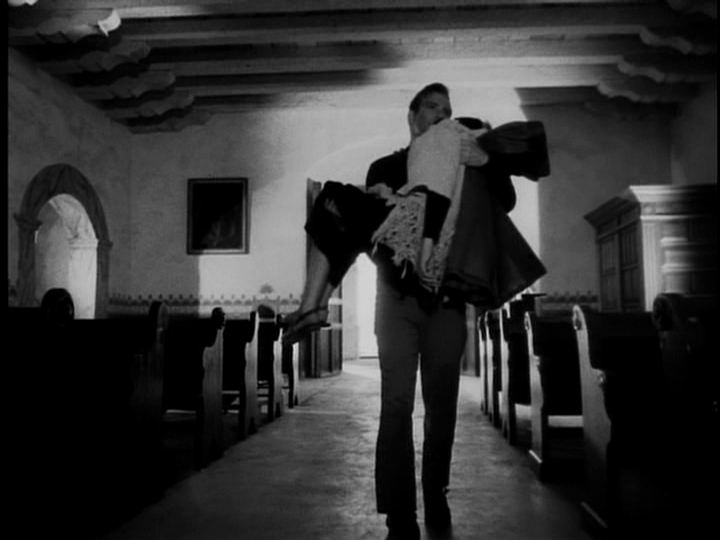
The movie's deliberate pace and philosophizing dialogue are certainly reminiscent of Bergman, as is the positively gorgeous cinematography by Conrad Hall (of Butch Cassidy and the Sundance Kid and American Beauty fame). For many of the films we watch, we find ourselves struggling to find a decent screenshot; Incubus presents us instead with an embarrassment of riches, with almost every frame akin to a well-composed photograph.

It's true that, by using Esperanto, the events in Incubus become weirdly unmoored from any specific time, place, or culture: we literally have no idea when or where these events are meant to be happening. It's disorienting, and certainly contributes to the film's unsettled atmosphere. 

It's also true that, even to a non-speaker of Esperanto, the dialogue in this film is painfully stilted both in its delivery and its pronunciation: most of the actors -- who allegedly learned their lines phonetically, and on short notice -- are clearly uncomfortable with the language, and their line readings suffer as a result.

The interesting exception is Shatner, who (at least in the early going) is noticeably more fluent than his colleagues. We've read that he speaks Esperanto with a pronounced French-Canadian accent, but better that than a Southern California accent, n'est-ce pas? (Dude?)


Shatner's hammy behavior in the wake of Star Trek has made it easy to overlook that he's always been a committed, disciplined actor. Whatever his personal shortcomings, his fame is at least partly the product of dues paid through years of hard work, by being damn good at his job and giving it everything he's got.

In the case of Incubus, he does what he can to make the best of a difficult situation; while he can't singlehandedly elevate the film, he's certainly not a liability -- and almost had us believing he could carry this off.


We also took notice of Milos Milos as the titular incubus. Shame he was the perp in that murder-suicide we mentioned above, as there's real menace in his leering, demonic performance -- and while some of it is attributable to good direction and cinematography, this Serb clearly had screen presence.

But ultimately it's hard to see Incubus as anything more than a beautifully filmed miscalculation. Pretentious and portentous, it nonetheless manages to conjure an atmosphere of real foreboding -- but neither its muddled narrative nor the stiff cast supply the foundation needed for Incubus's atmosphere to amount to more than just ambience. It has the visual flair and tortured quality of a Bergman film, sure, but not the intelligence or finely crafted performances characteristic of Ingmar's work.

All in all, certainly worth seeing (especially in the most literal sense), but not a good film. Sorry, Cap'n.


As a side note, Incubus is just about the last movie in our massive review backlog that, when we began chipping away at it with our most recent Ed Wood entry, dated back to August 2014. Since kicking into high gear in October of last year, we've been covering films that we initially watched between December 2014 and December 2015. With over 50 films in the backlog it seemed insurmountable when we first started, but here we are, out of the woods.

For a variety of reasons we didn't watch many movies for most of 2016, though Incubus was one of the few; others -- at least the ones potentially relevant to this blog -- include:
  • Jungle Moon Men, one of the more offensively terrible films we've ever seen from a mainstream studio;
  • The Howling and King Kong, two films far too famous to need our two cents on 'em;
  • Chandu the Magician, an amusing but threadbare romp with Béla, and One Million Years B.C., a less enjoyable (and bone-stupid) romp with Raquel.
We won't be doing formal reviews for any of these, but funny story about The Howling. We had DVR'd what we thought was The Haunting of Julia, and let that recording sit for over a year before sitting down to watch it. The first minute or so didn't get taped, so we didn't see the opening titles and were thoroughly confused for about 20 minutes until we figured out what had happened. In retrospect we're glad we got the chance to see this landmark werewolf film, even if purely by accident.

In our next entry we'll cover the only two Mill Creek box films we watched in 2016. Once that's done, we'll be fully caught up, and from that point forward, everything you read from us will be hot off our cinematic presses and fresh in our minds -- which will, in turn, spare us the experience of having to watch the likes of Frankenstein 80, A Face in the Fog, and Midnight Phantom twice.

September 2018 will also mark the approximate 10-year anniversary of this project, with the anniversary of our first blog post coming two months after that; with roughly 70 films between us and the end of the 250-pack, perhaps it's not inconceivable (hi, Wally!) that we'll finish it up in time for the site's one-decade mark? We'll see!

Monday, May 29, 2017

What a doll

We're all about timeliness at the Umbrellahead Review; since today is a holiday (happy Memorial Day, everyone!), let's review two Santa-centric features, each with an adorable little tyke and her beloved dolly. 


Santa Claus (1959)

Grade: F

What else can one really say about one of IMDB's bottom 100 films of all time? Santa Claus is #87 as of this writing -- two spots below The Aztec Mummy Against the Humanoid Robot (1958), another K. Gordon Murray Mexican import redub special.

 
It's a bizarre offering, to be sure. Our man Santa lives in a crystal and gold palace in a galaxy far, far away (though simultaneously directly above the North Pole -- quite the astronomical feat!), and spends his free time playing a magical organ to accompany a flotilla of singing and dancing It's a Small World rejects.

Too racy for Disney, perhaps.
There's no Mrs. Claus in sight (hmm), but he does have a sweaty, hairy, shirtless blacksmith (double hmm) and Merlin the Wizard (yup) in residence to help him out with all the traditional accouterments necessary for Christmas Eve. 

This includes a giant key that opens every door on the planet, sleeping powder for the kiddies, and a massive collection of spy equipment focused squarely on Earth's children. 

This is naturally controlled by giant animatronic body parts.
Santa's particularly fixated on a handful of Mexican niños, among them adorable Lupita, a poor little mite who just wants a dolly for Christmas (plus one more to share with the baby Jesus, because she's just that good and pure).

Lupita really is a cute kid, we say without sarcasm -- we'd love to know what happened to her
Meanwhile, back on Earth (or maybe Pluto or something, since if Toyland is in outer space, why not Hell?), Satan interrupts a demonic dance party to summon his minion Pitch, who's tasked with leading the children of Earth astray (coincidentally, those same Mexican kids!) in order to defeat Santa Claus. 


OK, we'll buy that -- Mexico has its traditional devil-vs-the-shepherds pastorelas, so this modernized, kid-friendly version isn't completely out of left field. What follows is an often strange, yet ultimately harmless baturrillo of devilish trickery, strange ballets, and parents presented in rather coffin-like oversized gift boxes. 

Besides its seemingly interminable length, we count three factors that turn what could have otherwise been a so-bizarre-it's-wonderful surrealistic romp into a ¡dios-mío!-please-let-it-be-over slog.


First is K. Gordon Murray himself, who not only bastardized the original Mexican production (so say some sources -- we're not keen on doing a detailed compare/contrast ourselves), but lent his own voice as the omnipresent narrator, who just goes on and on and ON in that very 1950's false-excited tone, without letting any of the (dubbed) dialogue or action just, you know, speak for itself. 

LET ME TELL YOU ALL ABOUT WHAT IS HAPPENING!
The second is a sort of claustrophobic dinginess that infuses all the scenes, both indoors and out. The Eastmancolor film process probably plays a factor, but no doubt a low budget and poor production values didn't help. 


Even the Toyland scenes, with their over-the-top set pieces and giant key-shaped door openings, have a closed-in, suffocating feeling (bad lighting? poor camera angles?), and this ends up sucking all the brightness and life out of the action.


Finally, the absolute worst thing about the film (in our humble Umbrellahead opinion) is the eye-rolling, ear-gouging, almost physically painful repetition of Jingle Bells -- never a verse, always just the chorus, over and over and over again, whenever a musical cue was deemed necessary (which was often).

 
Whatever its other memorable bits -- I mean, a wizard in a Christmas movie? -- Santa Claus will forever be known to us as "that awful Mexican Jingle Bells thing." Sorry, little Lupita.


Christmas Evil (1980)
(aka You Better Watch Out)

Grade: D


Christmas Evil certainly had the potential for something greater than just seasonally mitigated obscurity. The film stars Harry Stadling (Brandon Maggart), a sad sack middle manager at the Jolly Dream toy factory whose fixation with Christmas stems from a traumatizing moment when he saw his mother in flagrante delicto with his Santa suit-clad father. 

Reminds us of (the later) Don't Open Till Christmas; however, unlike the murderer in that film, the experience doesn't make Harry want to kill Santa -- it makes him want to be Santa. 

Paging Dr. Freud...
From the rooftop of his modest apartment (filled with Santa kitsch -- posters, dolls, the works) Harry spies on the neighborhood children, recording their every act in a custom-embossed pair of leatherbound tomes of, yes, Good Boys & Girls (including little Susy Lovett and her doll -- "just a darling") and the corresponding Bad ones. 

His bookshelf shows volumes labeled '78 through '80 -- where did one have books like that produced in 1980? The local Kinkos? Mail order?
OK, a bit sad and more than a little odd, but so far nothing overtly sinister. What follows is Harry's transition from neighborhood creeper to holiday killer.

Here's why Christmas Evil had potential: its murderer is not, for once, a comprehensively psychotic yet remarkably clever and capable mastermind, able to carefully plan the minutest details of complex crimes and cooly elude capture, all while being completely batshit crazy. 

Hello? Is this every modern crime show on TV?
Rather, this is the slow burn of a sad, unbalanced man being gradually pushed over the edge by the thousand small cuts of an uncivil society: his boorish bullying co-worker; a snotty little boy ogling Penthouse (whose mother happens to be played by Mrs. Tim "The Tool Man" Taylor, Patricia Richardson); the greedy corporate bosses who value profit over charity.

Fed up with the injustice (and unwholesomeness) of it all, Harry focuses on transforming into the jolly elf himself -- the perfectly-padded suit, well-glued facial hair, fancifully painted van-turned-sleigh -- to put right all the perceived wrongs. 

That he goes on to commit murder is only a byproduct of this strange, misguided, rather bumbling quest to restore Christmas cheer to his small slice of the dirty, cruel world.

Where the film fails is not in the premise, but the writing and direction (both by Lewis Jackson). It sort of wants to be a black comedy -- and it probably would have made a great one! -- but is neither black nor comedic enough to pull it off. 

There are a few exceptions.
It really wants to be a slasher flick, but lacks the punch, suspense, and shock factor of even the more mediocre ones (not to mention that the body count is rather low). 


Key scenes are poorly shot and end up murky and hard to follow; the film's timeline isn't well defined (though we figured it out on second viewing), which also adds further confusion. 

It follows a pattern we've often seen in underwhelming films -- an intriguing premise, a middle third that drags, and a rushed finale that doesn't really fulfill the promise of the beginning. Brandon Maggart was well cast and did his best, but ultimately, Christmas Evil belongs on the Bad list.